Daily BriefIssue 074
Six Trade Files Move Across Canadian Steel, Section 338, Iran Sanctions, and Fertilizer
Open the file tied to today's decision: contract qualification, duty treatment, sanctions screening, USMCA planning, or a Section 301 evidence build.
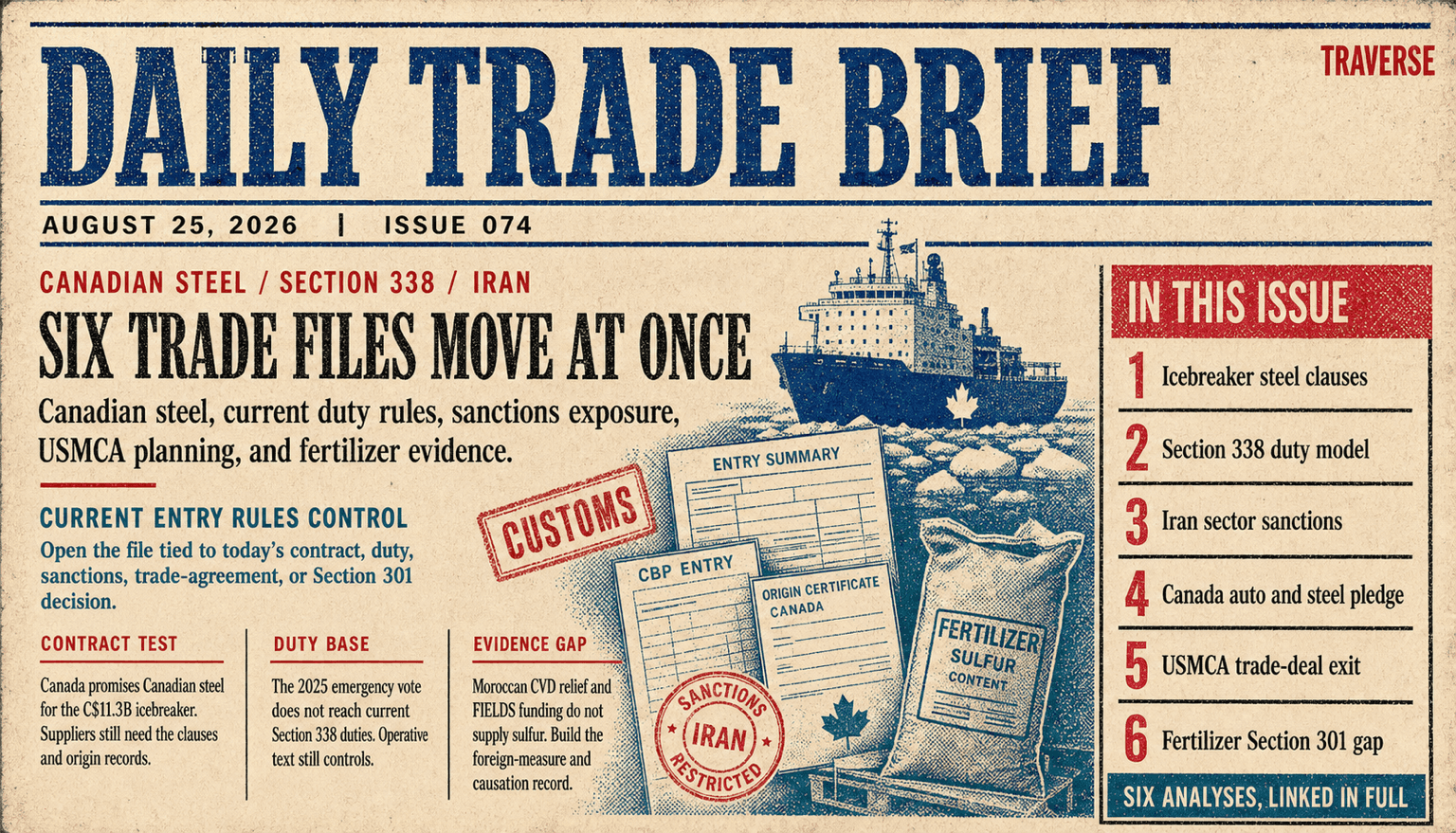
Good morning. Yesterday's six analyses moved separate procurement, duty, sanctions, trade-agreement, and fertilizer files. None changes every file at once.
Canada says its C$11.3 billion icebreaker award will use Canadian steel. Suppliers still need the contract clauses and origin records before pricing.
Read it in full: Canada Has Not Disclosed Its Icebreaker Contract's Canadian Steel Test.
The 2025 Canada emergency vote does not reach current Section 338 duties. Importers need enacted text or presidential action before changing the duty model.
Read it in full: The 2025 Canada Emergency Vote Does Not Reach Section 338 Tariffs.
Treasury expanded E.O. 13902 designation exposure and suspended five Iran authorizations. It did not impose a country-wide tariff or automatically block every sector participant.
Read it in full: Operation Economic Outcast: Five Sectors, Three Compliance Decisions.
Trump's pledge to raise tariffs to 50% on January 1, 2027, leaves no single duty base for Canadian autos, parts, trucks, or steel. Current entry rules control.
Read it in full: Trump's 50% Canadian Auto and Steel Tariff Pledge Has No Single Duty Base.
Washington reportedly sought limits on Canada's future trade agreements. Article 32.10 is narrower: it requires notice and text review for FTAs with a defined class of non-market countries, then gives the other parties a six-month termination option after entry into a covered FTA. It gives Washington no approval vote.
Read it in full: USMCA Article 32.10 Creates an Exit Option, Not a U.S. Veto on Canada's Trade Deals.
Current Moroccan CVD relief and FIELDS funding do not supply sulfur to curtailed incumbent plants. Producer counsel should establish the alleged foreign measure, government nexus, and causation before filing a Section 301 petition.
Read it in full: Mosaic's Sulfur Curtailment Exposes a Gap in U.S. Fertilizer Policy.